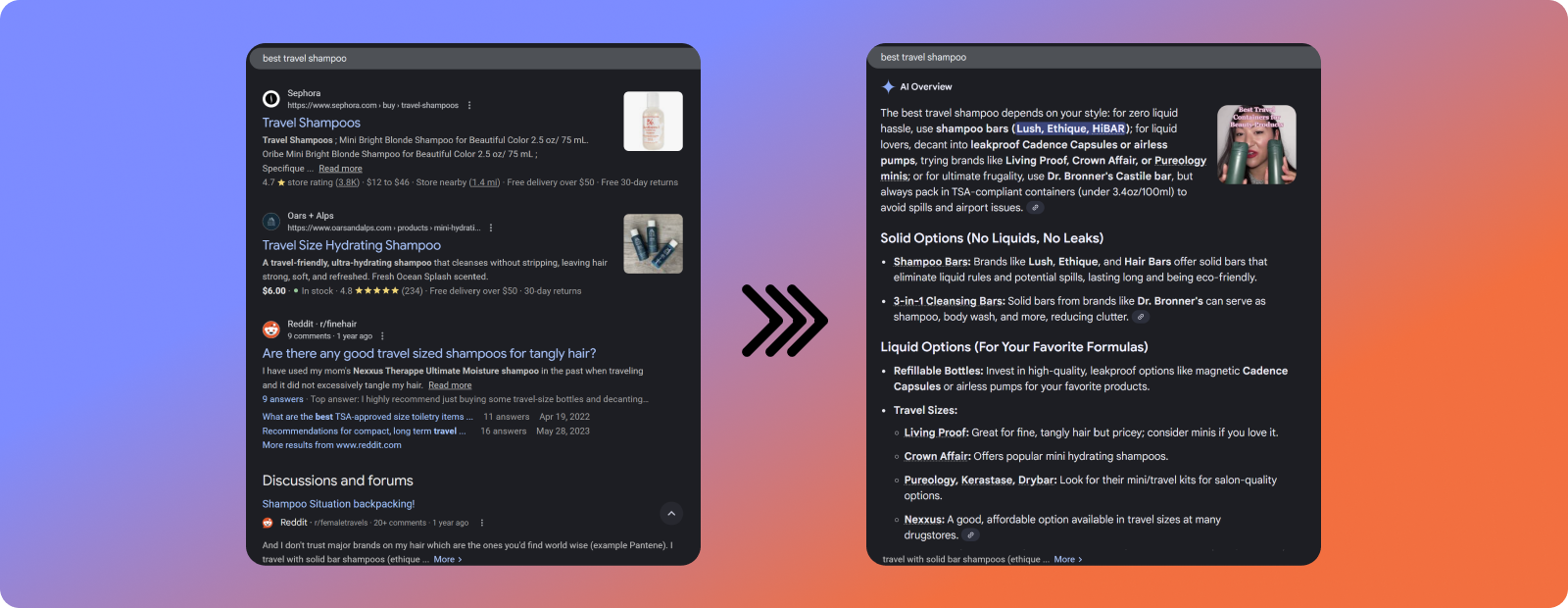
Any marketer knows that nothing connects better than a story that’s tailor-made for your audience. But your audience is evolving; no longer marketing to just humans, brands need to also appeal to AI to get their products selected.
Before the dawn of AI, brands perfected the process of defining who that audience is, where to find them, and what matters to them. Brands knew the “how” of your story by heart: its hook, the beats to hit, a pause for effect, and an ending with emotional appeal that makes your value proposition feel memorable and undeniable. But the rise of AI is rewriting what we know about audience and appeal.
For the year ending June 2025, about 20% of Americans reportedly used AI tools to help with their shopping.1 And more recent data from Bain suggests that number is now between 30-45% leading into the holiday season.2
With more and more consumers beginning to adopt the cutting-edge tools at their fingertips and confidently integrate them into daily, seasonal, and one-off shopping tasks, marketers need to know how best to connect with all the eyes and ears that matter most.
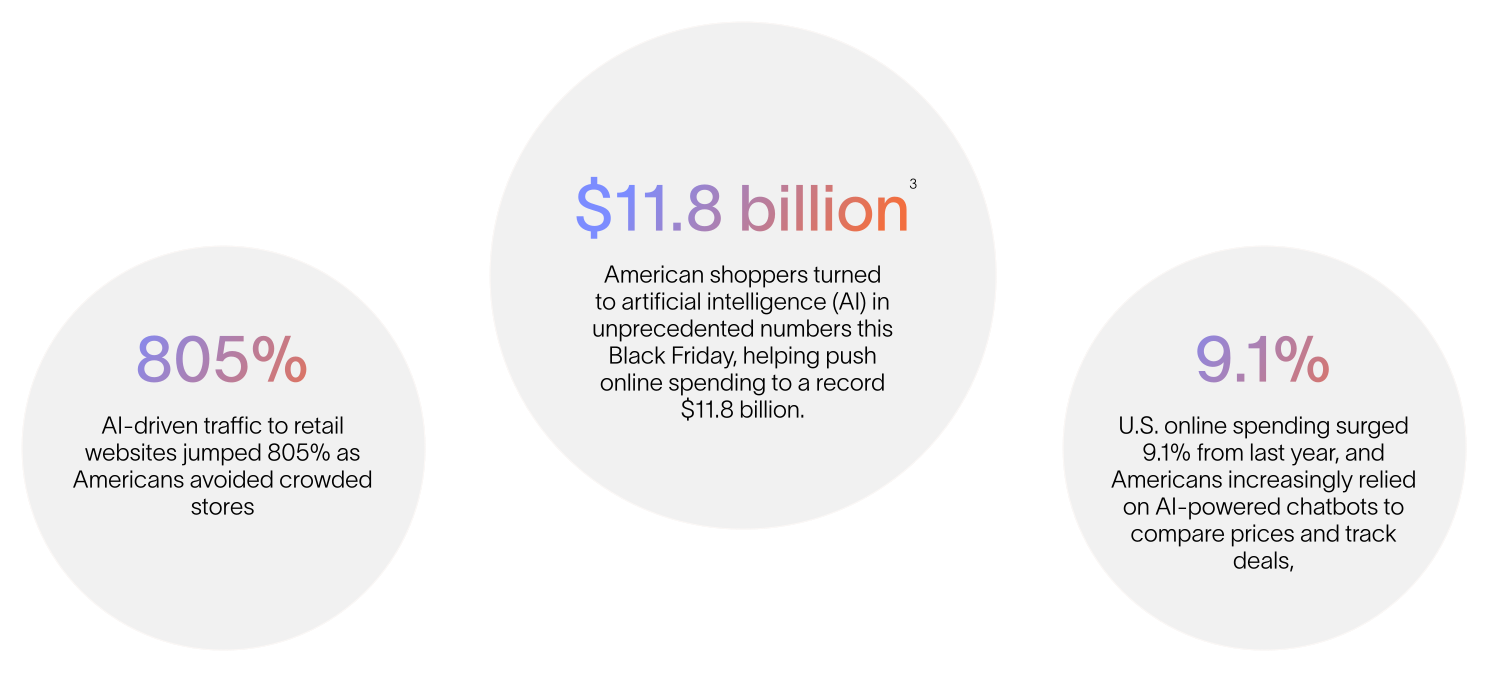
For brands, your ultimate goal is still to reach shoppers with the power to click “Purchase,” but the headline of the moment is the importance of reaching AI agents who increasingly represent those shoppers in today’s retail market.
This new view of “consumer” audience doesn’t have to mean a page-one rewrite of marketing strategy. With an understanding of some new fundamentals and a partner like Novi to help you keep a finger on the pulse through measurement and response, you can set your own stage to excel in a marketing landscape defined by agentic commerce.
Consumers are getting acquainted with a remarkable array of new tools that connect them with the products they want. You should too.
The cast of AI-driven assets in today’s market is large and growing larger. Most broadly, there are the Swiss army knife-style LLMs like OpenAI’s ChatGPT, Anthropic’s Claude, and Google’s Gemini. These systems will quickly offer advice on washing windows, composing a cover letter, or avoiding jet lag. But they can also help research products or dig up discount codes.
New features within these tools are shining an ever-brighter spotlight on their unique utility when it comes to shopping. For instance, take the September launch of ChatGPT’s Instant Checkout.
Instant Checkout makes it possible for shoppers to buy products from Etsy and Shopify vendors without leaving the ChatGPT window where they sought suggestions in the first place. This functionality applies to a couple of platforms now, but OpenAI made the infrastructure that supports the feature open source. So other parties who see the value of connecting with an AI audience that increasingly mediates the market for human shoppers can connect themselves to this engine for discovery and purchase.4
Fast forward barely two months later; that’s how quickly the market is moving. Just before Thanksgiving, OpenAI doubled down on cementing ChatGPT’s value to shoppers with its new shopping research tool. It’s been trained specifically to guide users through product discovery and comparison by structuring dialogue around concise, multiple choice-style questions.
Shoppers enter a query and are prompted to clarify key factors like price, quality, or use case before ChatGPT turns to the web at large to play the role of the buyer’s agent. The suggestions it returns come in the form of easy-to-read tables with all the information the buyer wants to weigh, with sources cited and follow-up questions about what the user likes or dislikes among the AI-vetted options.5
Marketplaces like Google Shopping are adding similar features that operate across all of the brands that appear on the platform. The latest features even allow shoppers to script some future purchase actions by naming the prospective discounted price at which the AI agent should remind them to buy a given coat, coffee table, or package of pet food. If the reminder arrives and the shopper confirms they still want the item, the AI agent can then go ahead and execute the purchase on the shopper’s behalf.6
AI isn’t just the domain of big tech and niche retailers.
Plenty of beloved brands and internet outposts tied to massive brick-and-mortar retailers have already developed their own chat-based AI assistant programs. Shoppers can engage with these tools to focus their search, discover and compare products across the many lines offered by a single retailer, and complete purchase processes.
AI-driven programs like these are framed as an opportunity for shoppers, but don’t forget to flip the script. Retailers and brands with a sharp eye for strategy will also recognize that building connections with these silicon-driven personal shoppers is the new way to reach the humans who love their products today or could tomorrow.
The scope of AI involvement in the shopping process is evolving on a near-daily basis. It will only become more essential to know these players and how to reach them if you want to avoid losing the plot.
Before we charge ahead, take a deep breath! Here’s some good news: A few smart moves can put your new audience within reach.
The charm of a Super Bowl ad with an undeniable punchline or a tear-jerking holiday campaign from a legacy brand is undeniable. Everyone loves a great story, and marketers love to tell them because shoppers are drawn to products that evoke good feelings.
But as AI increasingly plays middleman between brand messaging and consumer curiosity, don’t lose sight of your products’ key concrete attributes. Machine learning systems are designed to foreground reliability and expertise, so observe some key tenets of AI Engine Optimization (AEO) and make sure your product data is built out in terms they understand.
Don’t stop at verifiable ingredients, materials, and measurements; emphasize reputable badges and certifications your products have earned to make it even easier to stand out to these systems.
Schema markups aren’t just for keyword search anymore. Incorporate this rich product data not only into your marketing website’s descriptions and visuals but also into your schema for easy AI discoverability.
Ensure that this data is also pushed to any relevant stage beyond your own webpage. Consistency across other retailers and platforms that could showcase your products makes you more discoverable in the eyes of AI.
A stable of thoughtful keywords still does the trick when it comes to SEO, but the advent of AEO demands that your product schema puts a close-up on strategies like those outlined above. Traditional search engine queries are expected to chart a 25% decline in 2026 as AI becomes more popular across demographics and use cases.8 Referrals to retail sites via AI have already jumped from 1.7M in October 2024 to 14.4M this October.9
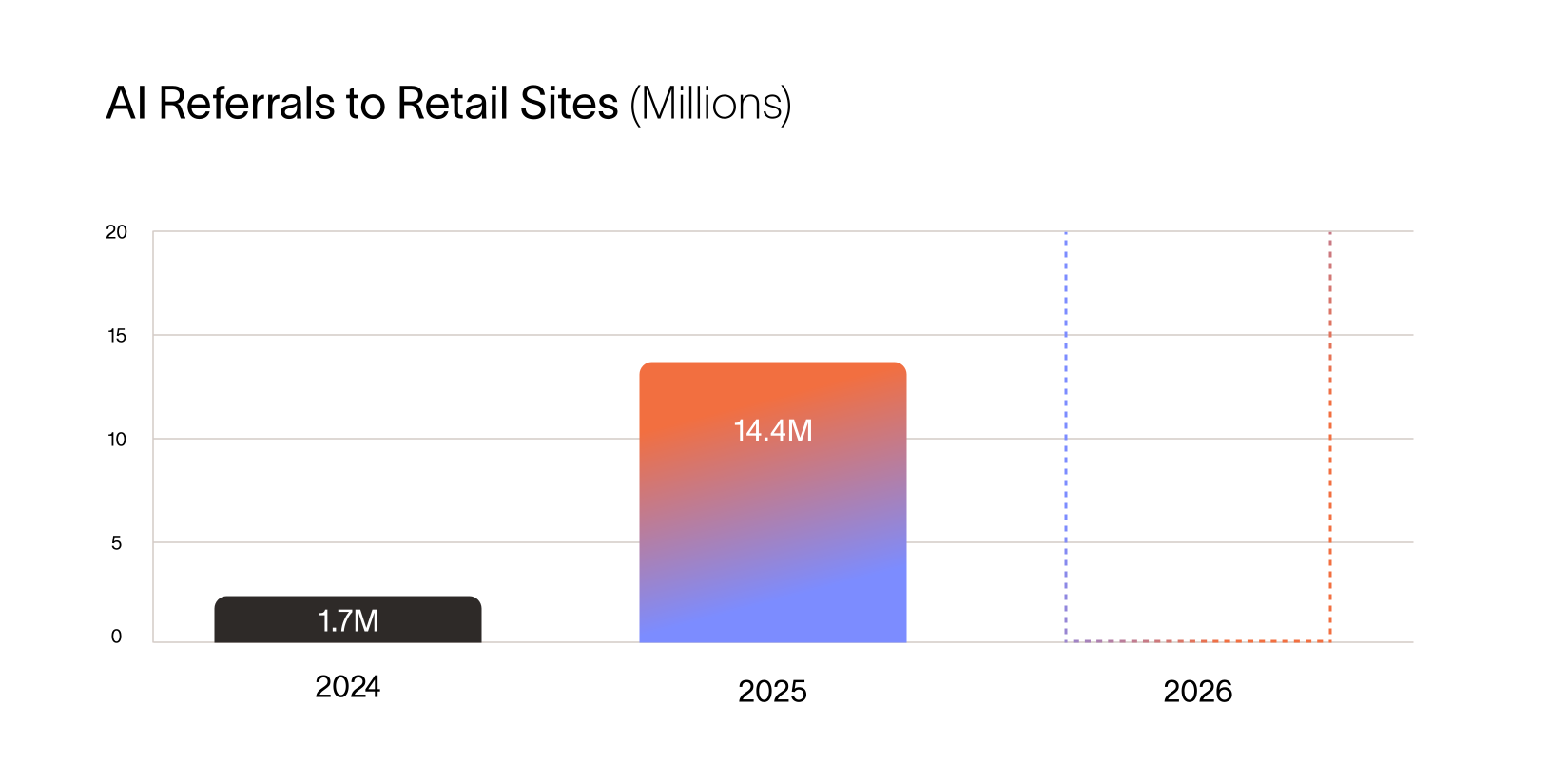
That story is still being written, but the trend demonstrates that an AEO-oriented approach isn’t just about marginal gains in the near term. It’s about positioning your products to hold center stage as shoppers’ collective comfort with AI-driven shopping develops even further.
To do so, it will be essential to understand not only the data that will attract attention from AI, but also the optimal ways to package it. Current research indicates that these systems are more inclined to pull from pages that frame product information with conversational questions similar to those a user would pose to ChatGPT. It may also be helpful to deliver your data and certifications in snapshot structures like grids, lists, and short paragraphs that AI systems can easily flip to users with nothing lost in translation.10
Still need convincing? Look no further than OpenAI’s launch announcement for ChatGPT’s shopping research elements, and you’ll see a few things. You’ll see that the story AI is telling is clean and concise, conversational but detailed. You’ll see that it’s structured to care about a buyer’s context and a seller’s reputable verifications.
What you’ll see is not just an original story authored by an LLM. It’s a story told by a marketer, heard by AI, and relayed to a motivated shopper.
As e-commerce and agentic commerce continue to shift and merge, some brands and retailers will step up. Sooner or later, the rest will have to catch up. Whether you’re wondering how AI perceives your products, outlining a process to make your data LLM-friendly, or already reworking your story, Novi can help you take the steps that will connect you with the machine audience being polled by more shoppers every day.
1. Gaudiaut, Tristan. “U.S. Consumers Warm Up to AI Shopping Tools.” Statista, Link.
2. Cheris, Aaron, et al. “Agentic AI in Retail: How Autonomous Shopping Is Redefining the Customer Journey.” Bain & Company, Nov. 2025, Link.
3. Compton, Sophia. “Black Friday Online Spending Hits Record as American Shoppers Embrace New AI Technology.” Fox Business, Nov. 2025, Link.
4. Arya, Vibhu. “AI Goes Shopping: Inside the New Era of Agentic Commerce.” The Fashion Law, 28 Oct. 2025, Link.
5. OpenAI. “Introducing Shopping Research in ChatGPT.” OpenAI, 24 Nov. 2025, Link.
6. Google Augments AI Shopping with Conversational Search, Agentic Checkout and an AI That Calls Stores for You.” TechCrunch, 13 Nov. 2025, Link.
7. Khan, Mahvish. “How AI Search Is Changing Holiday SEO – And What Retailers Can Do About It.” Salesforce Blog, 22 Aug. 2025, Link.
8. Gartner, Inc.. “Gartner Predicts Search Engine Volume Will Drop 25% by 2026, Due to AI Chatbots and Other Virtual Agents.” Gartner Newsroom, 19 Feb. 2024, Link.
9. Cheris, Aaron, et al. “Agentic AI in Retail: How Autonomous Shopping Is Redefining the Customer Journey.” Bain & Company, Nov. 2025, Link.
10. Partner Content. “The New AI Marketing Playbook.”Wired, Link.