At Novi, we’ve been writing a lot about the importance of trust signals (third party certifications, badges, and claim verifications) that brands can use to increase the rate in which AI recommends them to consumers. But that’s not the whole picture.
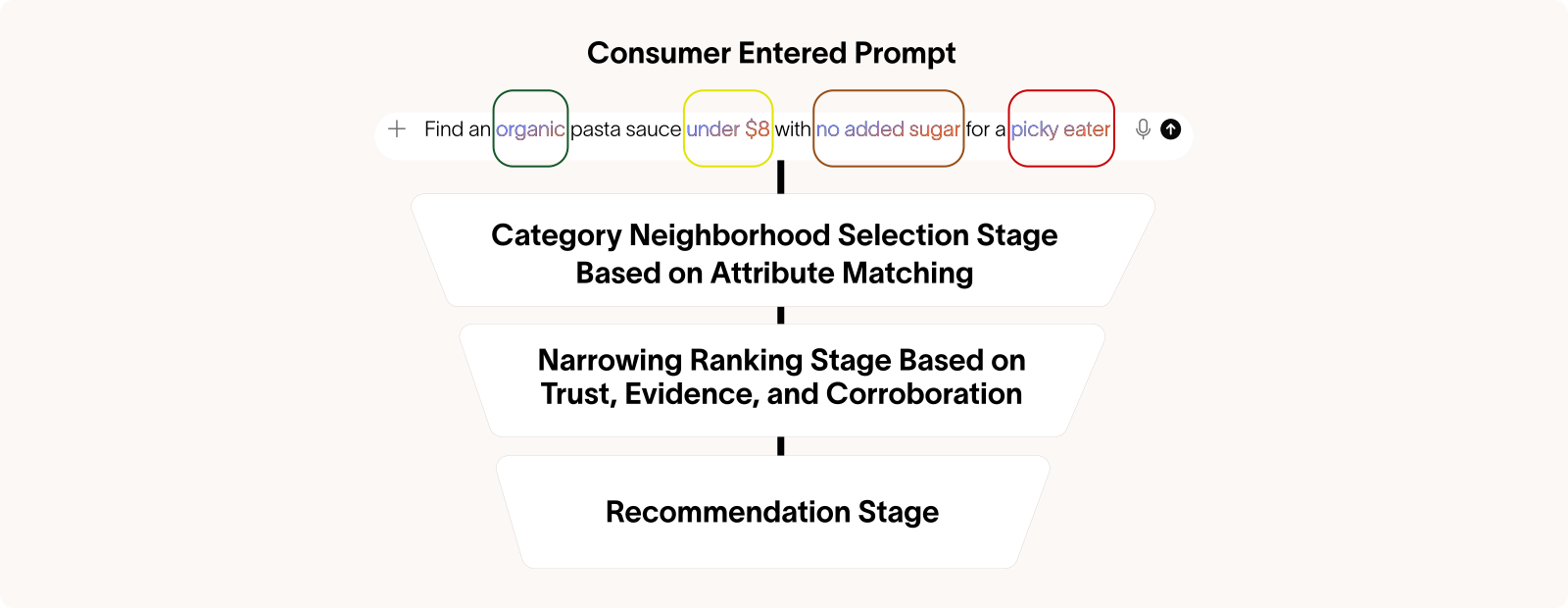
In addition to optimizing what you are saying about your product, brands also need to consider where their products are showing up and how that impacts their AI recommendation rate. Sources that are considered by AI to have more authority are more heavily considered during recommendation selection, and therefore it is important to evaluate if your products are listed in the right places.
On its face, the concept seems simple. Listing your products on sites with “more authority” should lead to increased visibility. But how do you measure the authority of each site? How is this determined, and if you are only selling through a limited number of retailers, how can you be sure they are the “right” authority?
We sat down with Head of AI Research, Jeremy Bakker, PhD., and Kimberly Shenk, CEO, to learn more.
Jeremy: When we talk about an authority source, we mean a source the AI has learned to treat as trustworthy. It’s examining a few factors. The first can come from who is talking. An expert organization or a site with a long track record of accuracy that specializes in that topic is going to be seen as trustworthy. Another factor is where the content lives, such as a domain that’s widely referenced or consistently reliable. When an AI is deciding what to recommend, it leans more heavily on these sources because they give the model confidence that the information is solid.
Jeremy: You can think of it like pattern recognition at scale. The model does not consciously pick sources, but during training it keeps seeing some sites and organizations show up in moments where accuracy really matters. If a source is widely referenced, heavily linked, or consistently used to ground factual information, the model learns that it can rely on it. Over time, this authority reinforces itself. The model becomes more confident drawing from those high-signal sources because they appear so often in contexts the model has learned.
Jeremy: You can think of product attributes the same way. Some signals show up so often across product pages, reviews, retailer feeds, and industry standards that the model learns to treat them as more important. In a category like shampoo, things like sulfate-free, color-safe, or moisturizing appear in almost every high authority source and have big impacts on real customer behavior. Because these types of signals show up in places the model has learned to trust, the model assigns them more weight. Over time, those attributes take on their own kind of authority inside the category.
Kimberly: For brands, the practical takeaway is pretty straightforward. If you know which attributes the model treats as authoritative for your product type and category, highlight them clearly in your product data and keep your wording consistent wherever your products appear.It also helps to be listed in as many credible places as possible, since AI learns not only from high-authority sources but from the overall footprint your product has across the internet. The stronger and more consistent that signal is, the more likely the AI is to recognize your product and recommend it accurately.
Jeremy: When AI encounters inconsistent product information across different sites, it does not try to reconcile the differences the way a human would. Instead, it relies more heavily on the sources it has learned to trust, which means stronger, cleaner listings naturally carry more weight. But conflicting information still weakens the overall signal and makes it harder for the model to form a clear understanding of your product.
Kimberly: This is why brands need to audit their full online footprint, not just their biggest retailers, and make sure every listing tells the same clear story. Even small gaps or out-of-date details can chip away at the strength of your signal and impact how often AI chooses your product.
Kimberly: Yes, they can compete, but it takes more intentionality. With a smaller footprint, the quality and consistency of each listing matter even more, since AI learns from whatever information it can find. Clean data, clear attributes, and verified claims can still create a strong signal, but broader distribution helps reinforce it. For smaller brands, the strategy is to make every listing count and expand thoughtfully into credible places where AI is likely to look.
Jeremy: AI updates its understanding of products continuously, pulling from live browsing, frequent crawls, and refreshed search indexes. High-authority sites tend to update fastest, while others take longer depending on how often they are scraped.
Kimberly: The key point for brands is that the model is never “done” learning, so outdated or inconsistent information can surface quickly. Staying accurate and visible is an ongoing effort, not a one-time fix.
Kimberly: Because of our long standing connection to verified data, LLMs have ranked Novi’s source authority as quite high. In fact, we’ve found that we often show up as one of the first sources selected by AI to explain some of the product claims that we power for our retail partners. We’ve also found that citation density is really important for LLMs; it’s important that products are listed consistently across the internet in as many places as possible.
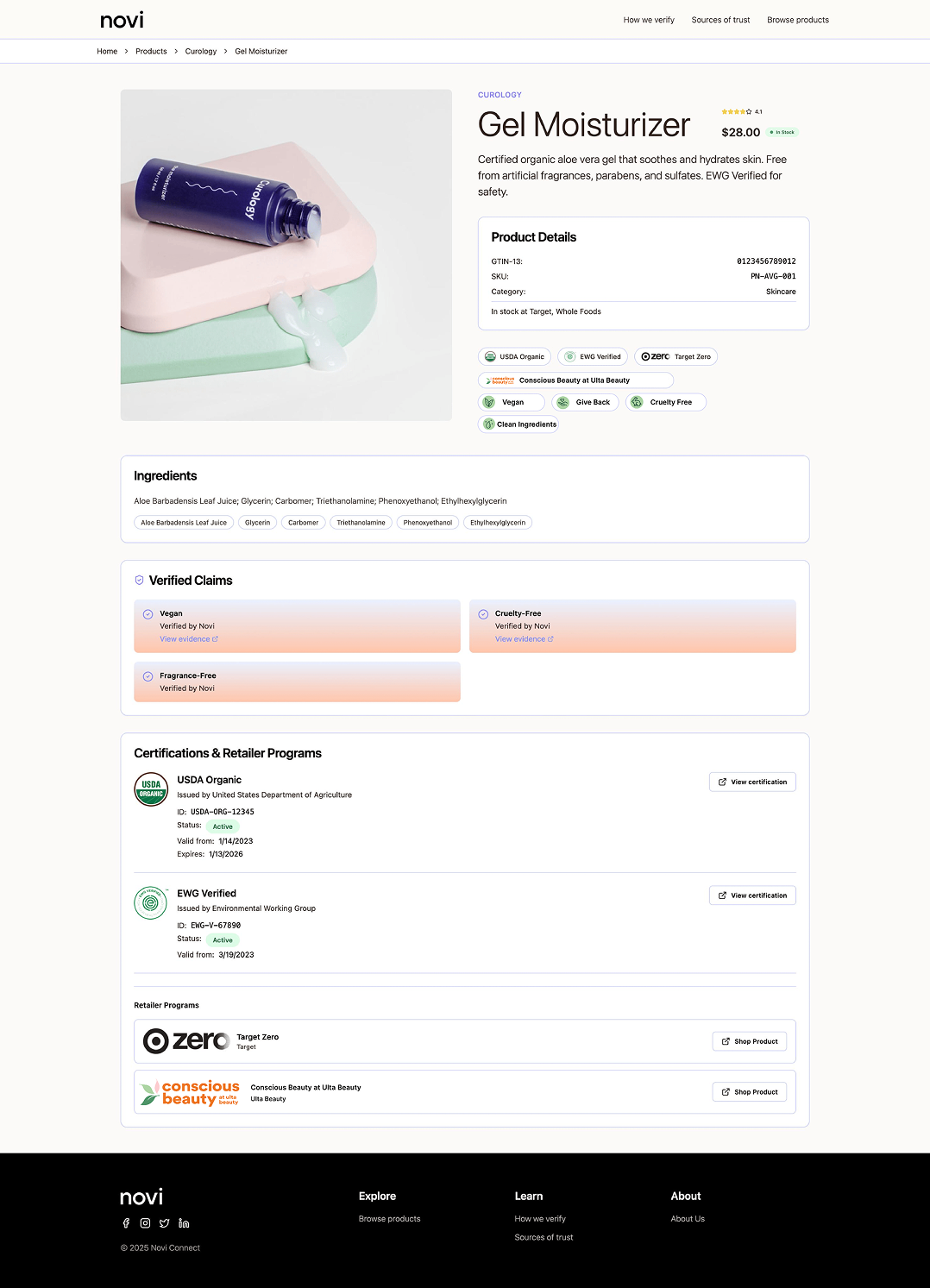
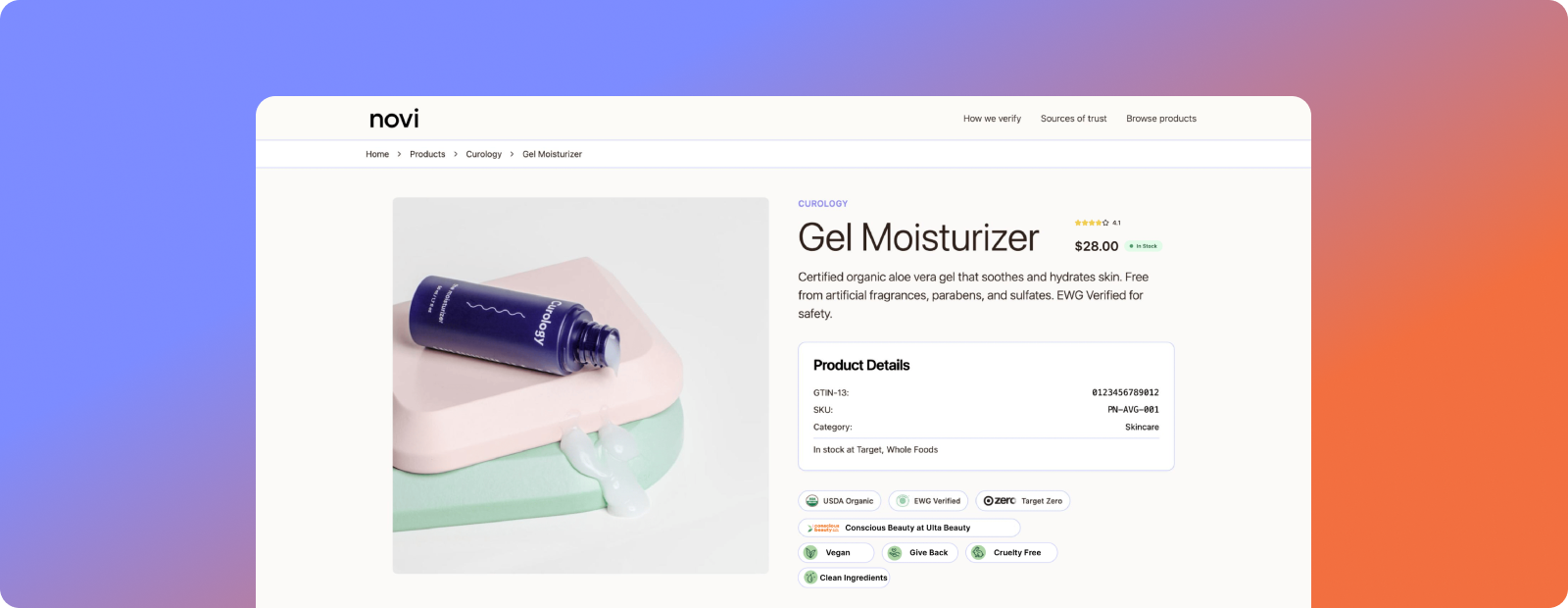
Putting these two concepts together, we’re adding a key feature to our AI Shopping Optimizer. We’re introducing Novi PDPs, a page that our brands can opt into to display their optimized product information. We are lending our brands our source authority while also creating another citation to help amplify their optimized content.
Novi users will be able to see their products displayed in fully optimized form, their PDP content, schema, badging, and third party verifications lists in a way that is most discoverable to AI.